
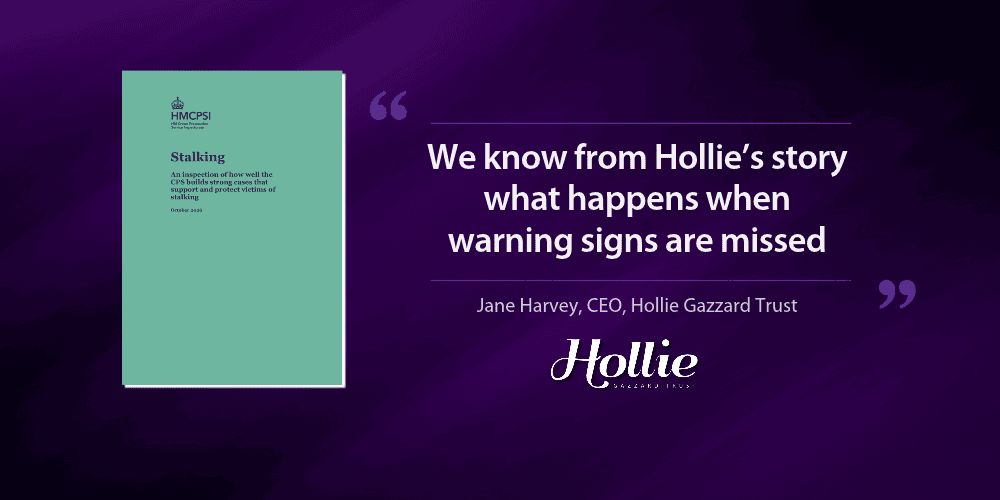
Hollie Gazzard Trust welcomes HM Crown Prosecution Service Inspectorate’s report, which looks at how the Crown Prosecution Service builds stalking cases and protects victims. As members of the National Stalking Consortium, we participated in this inspection, helping to shape its focus and making sure victims’ experiences were heard. Many of the concerns we and other consortium members raised are reflected in the report’s findings, including the use of Stalking Protection Orders, communication with victims and making sure stalking is charged as stalking. We thank the Inspectorate for engaging with us throughout.
Our charity exists because of Hollie. In 2014 she was murdered by a former partner whose stalking and harassment had warned of the danger she was in. Every finding in this report matters to us because we know how a missed warning sign can end.
We want to recognise the progress the report records. Inspectors found no evidence that prosecutors routinely downgraded stalking to lesser offences, which was a long-standing concern. Prosecutors considered bail in 85% of cases. They considered restraining orders at charge in 81% of cases and applied for protective orders in 94% of the cases where they could. Special measures to support victims at court were widely used. We also welcome the CPS Stalking Action Plan 2026–2030. Many dedicated prosecutors and Area stalking leads clearly understand how serious this crime is.
Good intentions are not the same as consistent protection, and the report is clear that performance “was not consistently good enough.” Several findings worry us deeply:
• Risk is being missed. Risk assessments were missing in nearly a third of cases, even though police have been required to provide one since 2018. Prosecutors chased the missing assessment in fewer than one in five of those cases. Stalking is about escalation, and you cannot judge escalation without assessing risk.
• Stalking Protection Orders are almost being ignored. SPOs were considered in just 3 of 200 applicable cases. That is not a gap; it is an almost complete failure to use one of the most important early protective tools available. Inspectors found most prosecutors viewed SPOs “primarily as a police responsibility.” That cannot continue.
• Victims’ voices are going unheard. Half of police files came with no Victim Personal Statement and no explanation of why. Of the cases that reached sentence, the CPS fully met its duties on the VPS in only 45%. Victims are entitled to tell the court how stalking has changed their lives. These reports are key to victim’s obtaining access to justice.
• Victims are being left uninformed. 39 victims entitled to the enhanced service under the Victims’ Code were wrongly treated as standard. More than a third of required letters went out late, and some were never sent. For someone being stalked, not knowing that a case has been dropped or changed is a safety issue, not an administrative one.
• Training is not good enough. Stalking-specific training was found to be “limited, outdated and not mandatory.” Stalking leads’ roles lacked clear definition and accountability, and several reported having limited time to do the job.
The Inspectorate says these failures arise not from missing guidance but from guidance not being followed. We agree, and that should concern everyone. The rules already exist. Victims need them applied every time, in every area.
1. Mandatory, specialist stalking training for all prosecutors. It should cover fixation, escalation, digital and technology-enabled stalking, Stalking Protection Orders and evidence-led prosecution, and be developed with specialist stalking organisations. The 2017 inspection called for all prosecutors to be trained in stalking and harassment. Nine years on, inspectors found training “limited, outdated and not mandatory.”
2. A renewed focus on Stalking Protection Orders. We would like to see the CPS and police work together so prosecutors routinely advise on SPOs in every case involving stalking, as the Inspectorate and CPS guidance already expect. Progress should be tracked so improvement can be seen.
3. Risk assessments at the heart of every charging decision. We would encourage the CPS and police to work together so that a full risk assessment is obtained and considered in every stalking case, as the Inspectorate requires, or that the reason one isn’t available is recorded.
4. Delivery of the Inspectorate’s VPS recommendation by April 2027 as a minimum, with every victim’s wishes about their statement recorded and carried out.
5. Formal, accountable stalking lead roles with protected time, and a national lead with the authority to hold Areas to account. We welcome the CPS’s commitment to clarify the role in its Stalking Action Plan 2026–2030.
6. Sustainable funding for independent stalking advocates. The report heard there are not enough of these services, and that capacity and resources are key issues. Within the CPS, they were described as able to “make or break a case”.
We welcome the Inspectorate’s commitment to a follow-up inspection in 18 months. We will be watching closely, and we hope that report shows the consistent improvement victims deserve.
Last week, the Hollie Gazzard Trust met with the Crown Prosecution Service to discuss how we can support improvements to the system and help ensure victims like Hollie have better access to justice. We welcomed the CPS’s openness to that conversation and look forward to continuing it. We hope to bring our experience of education, workplace training and the Hollie Guard personal safety app to support better training, earlier recognition of warning signs and stronger protection for victims. This report makes clear where that work needs to focus.
If you are worried that you are being stalked, trust your instincts, keep a record of every incident and contact the police. In an emergency, always call 999.
Funded by
